
Wasps, bees, and ants can sting. They can be a nuisance. So why do we love wasps?
Wasps, bees, and ants can also be agriculturally beneficial, aesthetically beautiful, and behaviorally charming. OK – few people might agree with me on the last points, but they do exhibit some really interesting behaviors. And many are social, so their behaviors can involve interactions with nestmates. Here are a few ‘side’ projects that I’ve worked on that produced some fun and interesting results (and videos).
Paper wasps (including yellowjackets, which nest underground) collect dry pulp by scraping untreated wood. They mix that with their saliva, bring it back to their nest, and gradually smooth it out to make paper nest cells, where the larvae will live and grow. Here, I gave “Champ” the wasp a different colored piece of construction paper every day for five days. Each day she added a layer to her nest, and the result was a rainbow nest. In the video, you’ll see Champ as she puts the finishes touches on this nest.
Paper wasps forage upon and eat pests of broccoli and cabbage. In this experiment, we placed four colonies of Polistes metricus in a greenhouse with broccoli plants being eaten by cabbage looper caterpillars (Trichoplusia ni). We found that not only are paper wasps effective at removing these pests, they are using the caterpillars to feed their own larvae. They are nature’s original organic pesticide, so keep them around your gardens if you can!
When honey bees swarm, they are not aggressive and will not likely sting you. Here, I demonstrate the organized chaos that occurs inside a honey bee swarm, and the drastic lengths I have to go to to get stung. This video serves only to illustrate that honeybee swarms are not aggressive. If you find a honey bee swarm in your yard, DO NOT approach it – they will still sting if caught in your clothes and they will fly around your head and land on you. Instead, either wait until they leave on their own for a new home, or call someone in your area who is trained in collecting honey bee swarms.
While excavating Vespula vulgaris wasp nests in New Zealand, the weka ran over and started squaking at us. After we collected the nest (secured in a container), this weka ran around and ate up some of the foragers. Spoiler – she gets stung.
Click image to go to video linked to the publication.
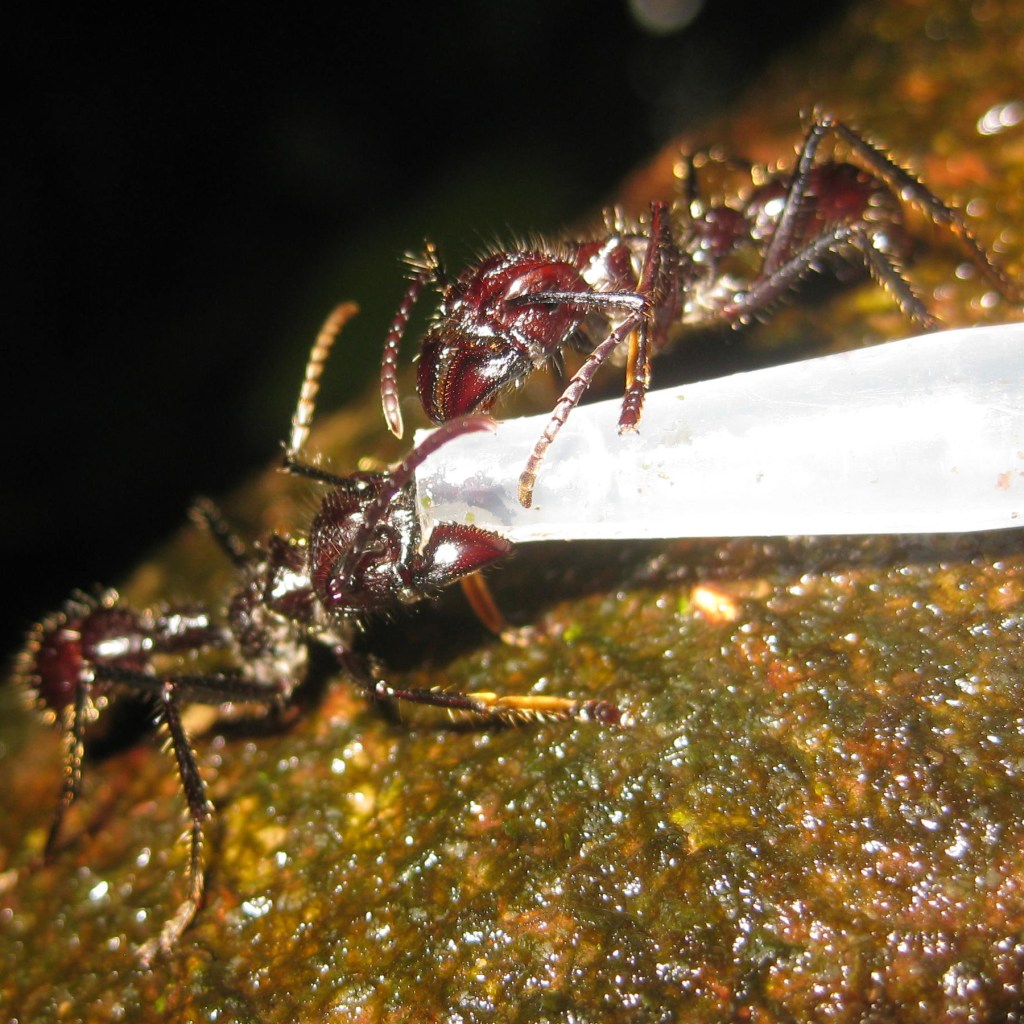
Bullet ants (Paraponera clavata) are named because if they sting you, it’s supposed to feel like you’ve been shot by a gun. They’re big tropical ants, that mostly forage in the forest canopy. In this experiment, we added casein, a protein supplement, to different concentrations of sugar water. We found that when sugar content was low, but protein content was high, wasps were more likely to bite at the the liquid, instead of using their mandibles to gradually drink it. To read more about this study, click here. To learn more about studying tropical ants, check out research being done in Terry McGlynn’s lab.
Dunedin, NZ summer 2023-24. We paint marked sweat bees, and monitored activity at the nest entrance. Here, you’ll see active bees flying around, and specifically:
- 00:18: bee at nest ZT pokes her head out
- 02:31: neighbor bee near ZT emerges and departs
- 02:57: white marked bee at nest ZT emerges, shows off her paint, and departs.
Iowa, US 2012. The bee shown above (in the bee family Halictidae; Order Hymenoptera) nests in the ground. As a solitary bee, she is responsible for feeding and protecting her young by herself. After I rearranged some of the weeds in the garden (and hence removed her visual cues), she had trouble re-locating her nest (where her hungry larvae were waiting for her to bring them food). Solitary bees are important pollinators. It’s important they have undisturbed space to nest, too.
Papatowai, NZ Summer 2024. A german yellowjacket wasp (Vespula germanica) captured a male sweat bee (Lasioglossum sordidum) as it was flying around outside of a community of sweat bee nests. A variety of predators lurk among these ground-nesting bee communities – and the presence of males makes these communities easier to locate.

